Overview
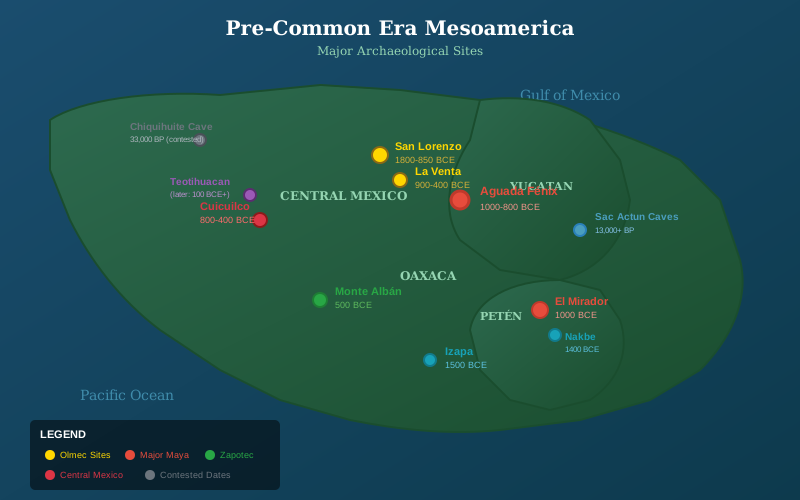
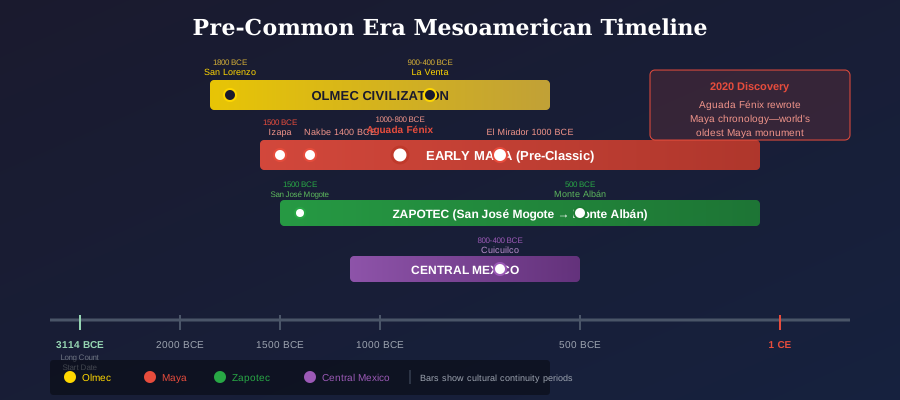
The archaeological record of pre-Common Era Mesoamerica reveals civilizations far more sophisticated and potentially older than scholars believed even a decade ago. Recent discoveries—particularly Aguada Fénix (1000-800 BCE), the world's largest and oldest Maya monument, and El Mirador's 72-meter pyramids (1000 BCE-150 CE)—have pushed back timelines for monumental construction by centuries.
Meanwhile, indigenous oral traditions preserved in texts like the Popol Vuh and the Aztec Five Suns cosmology describe multiple world ages spanning thousands of years, creating tension between indigenous accounts of deep time and mainstream archaeological chronology.
The most contentious dating claims, such as Byron Cummings' assertion that Cuicuilco's circular pyramid dates to 8,000+ BCE, have been rejected by radiocarbon analysis, though legitimate scientific debates about early occupation continue—with cave sites like Chiquihuite (Zacatecas) yielding contested evidence of human presence up to 33,000 years ago.
Contents
🗿 The Olmec Heartland
The Olmec civilization of Mexico's Gulf Coast, long called the "mother culture" of Mesoamerica, presents both confirmed early dates and ongoing origin mysteries.
Major Olmec Centers
- San Lorenzo — Earliest major Olmec center, flourished 1800-850 BCE with peak activity around 1150-920 BCE
- La Venta — Succeeded San Lorenzo, active 900-400 BCE
- Tres Zapotes — Persisted through 200 CE
The Colossal Heads

The 17 colossal heads—carved from basalt boulders weighing 6-50 tons and transported 50-80+ kilometers from the Tuxtla Mountains without wheels or draft animals—have long fascinated researchers. The engineering achievement, involving wooden sleds, log rollers, and balsa rafts on rivers, was accomplished within documented Olmec social organization.
Notably, 13 of 17 heads show flat backs, indicating they were recarved from earlier stone thrones—evidence of a sophisticated monument-recycling tradition.
Earlier Evidence
Evidence for even earlier occupation comes from the El Manatí shrine, where ritualistic deposits push Olmec dates to 1600-1500 BCE. Pre-Olmec cultures at sites like Zohapilco and Tlatilco show independent development of agriculture, writing, and ceramics, challenging the "mother culture" hypothesis that all Mesoamerican civilization diffused from the Olmec heartland.
Fringe Origin Theories — Debunked
The colossal heads have attracted fringe theories proposing African, Chinese, or Atlantean origins based on perceived facial features. A 2018 mtDNA study definitively showed Olmec remains belong to haplogroup A—indigenous American.
🏛️ Aguada Fénix Rewrites Early Maya Chronology
The June 2020 discovery of Aguada Fénix in Tabasco, Mexico fundamentally changed understanding of Maya civilization's origins. Led by Dr. Takeshi Inomata of the University of Arizona and confirmed through 69 radiocarbon samples, this massive platform represents the oldest and largest known Maya monumental structure.
Key Measurements
- Length: 1,400 meters
- Width: 400 meters
- Height: 10-15 meters
- Volume: 3.8 million cubic meters (exceeds Great Pyramid of Giza's 2.6 million)
- Construction Date: 1000-800 BCE
Perhaps most significant: no sculptures of rulers were found, suggesting communal construction without hierarchical leadership—challenging assumptions that monumental projects required kings and coercion. A cruciform pit at the site contains the earliest known directional color symbolism in Mesoamerica, linking it to Maya cosmological concepts.
Survey work following Aguada Fénix's discovery has identified nearly 500 similar smaller sites across southeastern Mexico, suggesting a previously unknown regional tradition of massive communal construction in the early first millennium BCE.
El Mirador — The Cradle of Maya Civilization
El Mirador in Guatemala's Petén jungle offers another paradigm-shifting perspective. Settlement began around 1000 BCE, with the La Danta pyramid complex reaching 72 meters tall and containing 2.8 million cubic meters of fill—requiring an estimated 15 million man-days of labor.
A 2022 LiDAR survey revealed 650 square miles of interconnected Maya settlement with over 1,000 sites linked by causeways (sacbeob).
Nakbe
Connected to El Mirador by causeway, Nakbe shows habitation from approximately 1400 BCE with monumental architecture radiocarbon dated to 600-400 BCE. Around 1200 BCE, villages were deliberately leveled to create platform foundations—evidence of planned monumental construction. Nakbe contains the earliest known Maya ballcourt (500-400 BCE).
🌋 Cuicuilco's Circular Pyramid and the 8,000-Year Controversy
No site has generated more alternative dating controversy than Cuicuilco, located in southern Mexico City. Its distinctive circular pyramid lies buried under lava from the Xitle volcano, creating conditions ripe for speculation about its antiquity.
Byron Cummings' Claims (1922-1925)
The University of Arizona archaeologist, finding 18 feet of sediment between the lava base and pyramid pavement, calculated 8,500 years for sediment accumulation, calling Cuicuilco "the oldest pyramid in the world." Geologist George E. Hyde estimated the Pedregal lava flow at 7,000 years old. These claims influenced Graham Hancock and other alternative researchers.
Modern Radiocarbon Dating Results
Over 30 radiocarbon dates place pyramid construction in the 5th century BCE (approximately 800-400 BCE), with the Xitle eruption occurring around 245-400 CE—some 300 years later than previously thought. The discrepancy arose from pre-radiocarbon misunderstanding of sediment accumulation rates and volcanic geology.
While Cuicuilco's extreme antiquity claims don't withstand scientific scrutiny, its significance remains: it represents central Mexico's first true city and one of the earliest monumental structures in Mesoamerica, with occupation beginning around 1200 BCE.
⭐ Monte Albán and Izapa Reveal Astronomical Sophistication
Monte Albán — Zapotec Capital
The Zapotec capital of Monte Albán in Oaxaca was founded around 500 BCE following earlier occupation at San José Mogote (1500-500 BCE). Its astronomical alignments demonstrate sophisticated sky-watching capabilities.
Building J
A distinctive pentagonal/arrowhead structure deliberately skewed 45 degrees from surrounding buildings, Building J shows:
- Alignments with the heliacal rising of Capella
- Possible alignments with zenith sun passage (May 2nd)
- Potential orientation toward Alnilam (center star of Orion's Belt)
Anthony Aveni's classic 1972 study documented these astronomical features.
The Danzantes carvings—over 300 bas-reliefs with Olmec-style traits depicting captive figures—and one of Mesoamerica's earliest (still undeciphered) writing systems connect Monte Albán to broader regional traditions.
Izapa — Bridge Between Olmec and Maya
Izapa in Chiapas serves as a bridge between Olmec and Maya civilizations. With occupation as early as 1500 BCE (contemporary with San Lorenzo and La Venta), its 89 stelae and 61 altars span 314 acres. Some researchers propose Izapa as the origin point of the 260-day ritual calendar. The site's axis aligns 21 degrees east of magnetic North toward Tacana volcano.
Stela 5 Controversy
Carved approximately 300 BCE-50 BCE, this complex "Tree of Life" scene showing 12+ human figures generated intense speculation. M. Wells Jakeman's 1950s claim that it depicted a Book of Mormon narrative is rejected by mainstream archaeologists. Scholar Julia Guernsey interprets it as depicting ritual activities within a "symbolic landscape of creation."
🌊 Underwater Caves Preserve Evidence of Deep Human Antiquity
The Sac Actun System—the world's largest underwater cave network with 358 cave systems spanning 1,400+ kilometers—preserves extraordinary archaeological evidence.
Chan Hol Cave
The Chan Hol II skeleton, dated via uranium/thorium stalagmite analysis, shows a minimum age of 11,311±370 years BP, with growth models suggesting approximately 13,000 years BP. This individual accessed the cave during the Younger Dryas period.
These caves, flooded approximately 8,000 years ago due to rising sea levels, contain evidence of:
- Humans mining iron-rich red ocher 10,000-12,000 BCE
- Megafauna fossils including giant sloths, gomphotheres, and saber-toothed cats
The "Naia" Skeleton
The famous "Naia" skeleton—a young woman who died approximately 13,000 years ago—represents some of the oldest confirmed human remains in the Americas.
Chiquihuite Cave — The Most Controversial Claim
Most controversial is Chiquihuite Cave in Zacatecas, where Dr. Ciprian Ardelean's team reported evidence of human presence 26,500-33,000 years ago in Nature (July 2020).
Supporting Evidence
- 1,930 stone objects identified as tools
- 46 radiocarbon dates
- Palm phytoliths unlikely to occur naturally at the 9,000-foot altitude
Scientific Skepticism
No human DNA was recovered despite extensive testing. Critics including Michael Waters (Texas A&M) argue current evidence doesn't support Americas occupation before 17,500 years ago.
☄️ Younger Dryas Impact Evidence in Mexico
At Lake Cuitzeo in central Mexico, researchers documented a black carbon-rich layer at 2.8 meters depth dated to 12,900 BP—the onset of the Younger Dryas cold period.
Published in PNAS — Key Findings
- Nanodiamonds (including hexagonal lonsdaleite)
- Magnetic spherules with rapid melting/quenching textures
- Carbon spherules
- Anomalous charcoal concentrations
- 92 wt% radiocarbon-dead or very old carbon
The layer represents "not normal plant-derived organic matter" that "cannot be explained by any known terrestrial mechanism." Lake Cuitzeo is one of 50+ sites worldwide showing this Younger Dryas boundary layer.
Scientific Status
The Younger Dryas Impact Hypothesis (YDIH) is currently considered "plausible or likely by a significant minority (25-30%) of active researchers," while most scientists attribute Younger Dryas cooling to freshwater discharge from Lake Agassiz weakening Atlantic circulation. Graham Hancock's "Magicians of the Gods" links YDIH to his "lost civilization" theory, proposing flood myths in Mesoamerican traditions represent cultural memory of this 12,900 BP event.
📜 Indigenous Oral Traditions Describe Multiple World Ages and Deep Time
The Popol Vuh and Maya Cyclical Creation
The K'iche' Maya Popol Vuh, transcribed 1554-1558 from pre-existing hieroglyphic manuscripts, describes four attempts to create humanity:
- Mud people: Dissolved in water
- Wood people: Destroyed by flood, hurricane, monster attacks, and rebellion of their own tools; survivors became monkeys
- Maize people: The successful current humanity, created by the Feathered Serpent (Q'uq'umatz) and Heart of Sky (Huracán)
Archaeological confirmation of the narrative's antiquity came from El Mirador stucco panels dating to approximately 300 BCE depicting the Hero Twins—500 years before Classic Maya florescence.
The Five Suns Cosmology of the Nahuas
Aztec/Nahua tradition describes five successive world ages, each destroyed by different catastrophes:
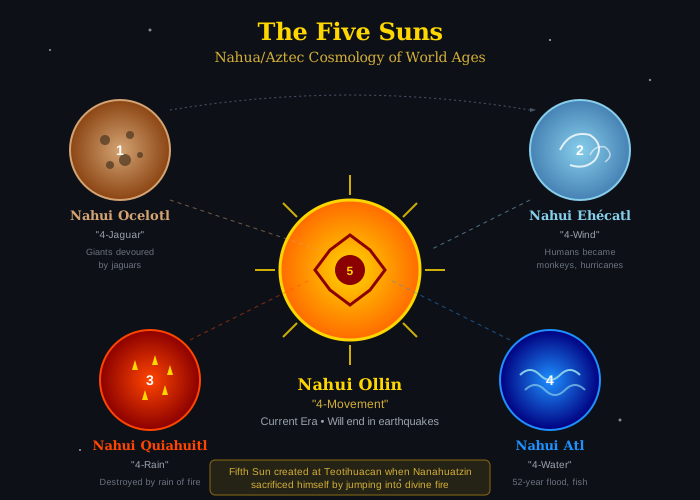
The Five Suns
Nahui Ocelotl (4-Jaguar): Giants devoured by jaguars
Nahui Ehécatl (4-Wind): Humans transformed to monkeys, swept away by hurricanes
Nahui Quiahuitl (4-Rain): Destroyed by rain of fire (volcanic)
Nahui Atl (4-Water): 52-year flood; humans transformed to fish
Nahui Ollin (4-Movement): Current era, predicted to end in earthquakes
The current Fifth Sun was created at Teotihuacan when the god Nanahuatzin sacrificed himself by jumping into divine fire. Quetzalcoatl retrieved bones from the underworld (Mictlan), sprinkling them with his blood to create current humanity.
The Long Count Calendar's Implications for Deep Time
The Maya Long Count calendar begins on August 11, 3114 BCE (GMT correlation)—predating the Egyptian pyramids (~2600 BCE), Stonehenge's final phase (~2500 BCE), and the Harappan civilization. The Maya recorded this date as the beginning of the current creation, implying previous creations before this point.

Remarkable Astronomical Accuracy
- Lunar month: 29.53020 days (modern: 29.53059 days)
- Mars cycle: Accurate to within 1 day over 780 years
- Venus cycle: Accurate to within 2 hours over 500 years
- Solar year: 365.2420 days (actual: 365.2422 days)
A 2025 study in Science Advances confirmed Maya eclipse tables in the Dresden Codex could predict solar eclipses centuries in advance, successfully predicting eclipses from 350-1150 CE using overlapping saros and inex cycles. The Maya accurately predicted the 1991 eclipse "to within a day."
Five Long Count cycles equal approximately 26,000 years—closely approximating the precession of the equinoxes. Whether Maya deliberately encoded precessional knowledge remains debated; a 2025 study in the Journal for the History of Astronomy concluded arguments for precessional understanding are "invalid and implausible."
🎬 Video Resources for Exploring Ancient Mesoamerica
Graham Hancock's Netflix Series
Ancient Apocalypse (Seasons 1 & 2, Netflix)
Explores Hancock's hypothesis of an advanced Ice Age civilization destroyed by cataclysm ~12,800 years ago. Season 1 features Cholula, Mexico (world's largest pyramid by volume) and examines Quetzalcoatl traditions. Season 2 (October 2024) visits Palenque and Chichen Itza, examining Maya astronomical expertise.
Scholarly Response
The Society for American Archaeology has formally criticized the series for "false claims and disinformation," and two featured archaeologists claimed their interviews were "manipulated and presented out of context."
INAH Official Documentaries
INAH TV (youtube.com/INAHTV)
Official Mexican government archaeology content with 100,000+ subscribers and 27+ million views. Key documentaries include:
- Teotihuacan: Bitácora del arqueólogo (Archaeologist's Log)
- Hallazgo de la Tumba 7 de Monte Albán (927,043+ views documenting Alfonso Caso's 1932 discovery)
- Los Cenotes (cenotes and ancient Maya customs)
- Palenque, Toniná, El Tajín, Paquimé site documentaries
- La pintura mural de Teotihuacan (premiering April 18, 2025)
Indigenous Perspectives and Maya Daykeeper Content
PBS's Mundo Maya (53 minutes)
Extensively features contemporary Maya voices including rapper Pat Boy (Jesus Pat Chable) performing in Mayan language, addressing Tren Maya impacts and cultural preservation. Available at pbs.org.
Apab'yan Tew
A K'iche' Maya Ajq'ij (Day Keeper) with roots in Nahualá, Sololá (Guatemala), offers interviews discussing traditional Maya calendar, spirituality, and ceremonies (thelifepathdialogues.com).
Edgar Martin del Campo (YouTube, 5.7K subscribers)
Descendant of Cora ancestors from Nayarit, Mexico, shares lessons from indigenous religions, cultures, and languages in English, Spanish, and Nahuatl.
The Ancient Americas (YouTube)
Educational content on Mesoamerican civilizations and hosts trips to archaeological sites including Zapotec sites in Oaxaca.
Academic Documentaries
Maya to Aztec: Ancient Mesoamerica Revealed
The Great Courses (Amazon Prime/Apple TV) by Dr. Edwin Barnhart of the Maya Exploration Center provides comprehensive lecture coverage from Olmec through Aztec civilizations.
Mirador: The Forgotten City (2009)
Features Dr. Richard Hansen showing the "cradle of Maya civilization." Additional El Mirador coverage has appeared on History Channel, National Geographic, BBC, Discovery Channel, and 60 Minutes Australia.
👥 Indigenous Scholars Centering Native Perspectives
Foundational Mexican Scholars
Miguel León-Portilla (1926-2019)
Pioneered the view that Nahuas developed genuine philosophy (tlamatinimeh—sages) comparable to ancient Greek thought. His Visión de los vencidos (The Broken Spears, 1959) presented indigenous perspectives on the Conquest. He demonstrated sophisticated metaphysical inquiry about existence through 90+ original Nahuatl documents rather than Spanish colonial sources.
Alfredo López Austin (1936-2021)
Focused on Mesoamerican cosmology and the concept of "animistic centers"—different soul/life forces (tonalli, teyolia, ihíyotl) in the Nahua understanding of personhood. His work traced mythological continuities across thousands of years connecting Olmec, Teotihuacan, Toltec, and Aztec thought.
Mercedes de la Garza
Emerita researcher at UNAM's Centro de Estudios Mayas and former Director of the National Museum of Anthropology. Emphasizes continuity between ancient Maya religious practices and contemporary shamanism.
Contemporary K'iche' Maya Scholars
Emil' Keme
Analyzes contemporary Maya poetry as decolonial resistance in Le Maya Q'atzij / Our Maya Word.
Irma Alicia Velásquez Nimatuj
K'iche' Maya journalist and social anthropologist who initiated the court case making racial discrimination illegal in Guatemala.
Rigoberto Quemé Chay
First indigenous mayor of Quetzaltenango (1994), promotes Maya University creation.
Maya Daykeepers Preserving Calendar Traditions
Contemporary ajq'ijab' (daykeepers) maintain the 260-day sacred calendar (Cholq'ij/Tzolk'in).
José Federico Munoz Manik Ahaob
Carries oral history from 1444-1529 as Day Keeper for Maya Chorti, K'iche', Mam, and Kaqchikel peoples.
Barbara and Dennis Tedlock
Anthropologists who trained as calendar diviners in Momostenango, Guatemala. Dennis Tedlock's Popol Vuh translation remains definitive.
2024 research by Ivan Šprajc and Takeshi Inomata using LiDAR mapping suggests the 260-day Maya calendar may date to 1100 BCE, centuries earlier than the previously oldest written record (300 BCE San Bartolo mural).
⚖️ Alternative Archaeology Claims and Mainstream Responses
John Major Jenkins' Galactic Alignment Theory
Jenkins (1964-2017) proposed in Maya Cosmogenesis 2012 that the Long Count was designed to track a "galactic alignment"—the December solstice sun aligning with the Galactic Center every ~26,000 years due to precession. He argued the 2012 end-date marked this alignment, representing transformation rather than apocalypse.
Academic Response
A 2025 academic paper in the Journal for the History of Astronomy concluded: "Analysis of Maya long numbers shows the arguments for such a proposal to be invalid and the claims implausible."
Olmec Origin Controversies
Multiple fringe theories have proposed non-indigenous Olmec origins:
- African origin: Based on perceived facial features of colossal heads; disproven by 2018 mtDNA analysis
- Chinese origin: Betty Meggers (Smithsonian, 1975) proposed Shang Chinese influences; Mike Xu claimed jade celts bore Chinese characters (shown to be Olmec maize god imagery)
- Atlantean connection: Various 19th-20th century attributions to Atlantean survivors
All such theories are rejected by mainstream archaeology, which documents indigenous development through archaeological continuity from earlier Formative cultures.
Zecharia Sitchin's Claims
In The Lost Realms, Sitchin proposed Olmec civilization derived from Sumerian/Akkadian civilizations, with Quetzalcoatl representing transferred Sumerian deities. His translations of Sumerian texts are universally rejected by Assyriologists and Sumerologists.
🔬 What the Evidence Actually Shows
The archaeological record reveals Mesoamerican civilizations were demonstrably sophisticated far earlier than scholars believed a generation ago:
- Aguada Fénix's 1000-800 BCE construction predates previous estimates for Maya monumental architecture
- El Mirador demonstrates state-level society a millennium before expectations
- The Long Count calendar's 3114 BCE starting date reflects indigenous understanding of deep time
Yet the most extreme alternative claims—Cuicuilco at 8,000 BCE, Atlantean Olmec origins, or definitive human presence at 30,000+ years—lack supporting evidence under rigorous analysis. Where radiocarbon dating exists, it consistently supports timelines measured in millennia rather than tens of millennia for civilizational development.
The Genuine Tensions
The real debates exist between:
- Indigenous oral traditions describing multiple world ages spanning thousands of years
- Archaeological evidence confirming civilization development from ~2000-1800 BCE forward
- The Long Count's 3114 BCE start date, predating physical evidence of Maya civilization by over 1,000 years
- Astronomical sophistication requiring centuries of observation before the earliest documented centers
These questions remain open not because mainstream archaeology "covers up" evidence, but because the relationship between indigenous mythological frameworks for understanding cosmic time and literal historical memory continues to be debated. What's certain is that the peoples of ancient Mesoamerica achieved remarkable astronomical, architectural, and intellectual accomplishments—achievements that belong entirely to indigenous Americans, regardless of when the timeline ultimately proves to have begun.
📌 Conclusion: Tensions Between Frameworks, Not Coverups
The evidence for pre-Common Era Mesoamerican civilization is robust and increasingly impressive. Recent discoveries have substantially pushed back timelines for sophisticated construction and social organization. The 1000 BCE threshold for massive monumental architecture is now well-established through multiple independent radiocarbon studies.
Indigenous oral traditions present a parallel framework describing cyclical world ages, catastrophic destructions, and multiple creations extending far beyond archaeological timelines. Whether these represent literal historical memory, sophisticated cosmological frameworks, or some combination remains legitimately debated. The Long Count calendar's encoding of astronomical cycles requiring millennia of observation suggests knowledge traditions extending deeper than material evidence confirms.
The Path Forward
The most productive approach recognizes that indigenous scholars and daykeepers preserve continuous traditions linking contemporary communities to ancient civilizations. León-Portilla's methodology—prioritizing Nahuatl and Maya language documents over Spanish colonial sources—offers a model for centering indigenous knowledge. Contemporary Maya ajq'ijab' maintain calendar traditions unbroken for millennia, representing living connection to pre-Hispanic intellectual traditions.
Alternative archaeology serves a useful function in questioning assumptions and highlighting anomalies. Its failures lie in proposing external civilizers (Atlanteans, Africans, Chinese, Sumerians) rather than crediting indigenous achievement, and in clinging to claims (Cuicuilco at 8,000 BCE) definitively falsified by radiocarbon evidence.
Related: Ancient Turtle Island
Explore the deep history of North America north of Mesoamerica—from the 24,000-year-old Bluefish Caves in Yukon to the astronomical marvels at Cahokia and Newark Earthworks. Indigenous oral traditions from the Haudenosaunee, Hopi, Lakota, and Ojibwe nations offer perspectives on Turtle Island's ancient past.
Related Videos from the Library
Explore videos featuring Mesoamerican archaeological sites and indigenous perspectives: